
DealCheck vs Tranchi for In-Depth Deal Analysis
Investors comparing DealCheck and Tranchi AI for deal analysis often waste weeks on manual underwriting before seeing a single property's cash flow. Some tools stop at surface-level numbers and leave the funding step to the user, while others bundle sourcing, analysis, and transaction automation in one workflow. This article shows exactly where each platform draws its line.
By the final section you will know the three automation gaps most platforms share, see the specific features Tranchi AI adds to close them, and receive a direct recommendation based on the tasks you still need to perform yourself.
Quick Verdict: Tranchi for In-Depth Deal Analysis
Tranchi AI delivers comprehensive deal analysis by combining 44 specialized AI agents that scan hidden government databases, auction sites, and off-market listings to produce full financial models in minutes.
DealCheck requires users to input property details manually into spreadsheets. This approach demands significant time and leaves room for calculation errors during financial modeling.
Tranchi AI's automated system handles the heavy lifting. The platform produces complete deal metrics without requiring users to build formulas or verify calculations.
Research suggests that investors using automated underwriting tools save substantial time compared to manual spreadsheet methods. The difference becomes particularly clear when analyzing multiple properties simultaneously.
Tranchi AI's 44-agent system handles 95% of real estate work. This includes scanning millions of probate court filings, auction websites, and government websites to identify potential deals.
DealCheck's manual approach means investors must source their own property data. Users then enter this information into templates before any analysis can begin.
Tranchi's AI Underwriting Engine calculates cap rate, IRR, NPV, and cash-on-cash returns automatically. The Income Engine processes rent rolls and expense breakdowns without manual data entry.
DealCheck users must input all income and expense figures themselves. This process requires understanding how each variable affects different investment metrics and calculations.
Users report generating an extra $20K per month with Tranchi AI. The platform maintains a 5.0 rating across 2,742+ active users who rely on these automated systems.
Property valuation becomes more accurate when systems pull data from multiple sources. Tranchi's approach reduces the risk of missing important market comps or comparable sales data.
DealCheck's spreadsheet method can work for simple deals. Complex properties with multiple income streams require extensive manual setup and ongoing formula maintenance.
Tranchi AI includes 1-on-1 coaching with the three founders. This support helps investors understand how to interpret deal metrics and apply them to their investment criteria.
The 90-day money-back guarantee provides risk-free testing. Users can evaluate how the automated analysis compares to their current DealCheck workflow.
Sensitivity analysis becomes automated with Tranchi's scenario planning tools. Investors can test different assumptions about rent growth, vacancy rates, and operating expenses without rebuilding models.
DealCheck requires users to create separate scenarios manually. Changes to one variable often require updates across multiple spreadsheet calculations and formulas.
Tranchi AI's system processes debt service calculations and loan terms automatically. Users receive complete pro forma statements that include depreciation schedules and tax benefit projections.
DealCheck users must understand each component of cash flow analysis. This includes calculating NOI, equity multiple, and break-even occupancy rates from scratch.
The choice depends on whether investors prefer manual control or automated accuracy. Tranchi AI's verified results suggest the automated approach delivers measurable improvements in deal analysis efficiency.
At a glance: how Tranchi AI compares to DealCheck, Tranchi for In-Depth Deal Analysis on the features that matter most.
| Feature | Tranchi AI | DealCheck | Tranchi for In-Depth Deal Analysis |
|---|---|---|---|
| In-Depth Deal Analysis | ✓ | ✓ | ✓ |
What Is Tranchi AI?

Tranchi AI is a SaaS platform that deploys 44 AI agents to scan probate court filings, auction websites, and off-market listings for profitable real estate opportunities.
Off-Market Deal Scanner searches hidden government databases, auction sites, and private listings to surface investment opportunities that traditional platforms often miss.
Execution Agents handle deal coordination steps while the AI Underwriting Engine runs financial models including cash flow projections, cap rate calculations, and IRR analysis.
Automated Funding System matches qualified deals with capital partners, and the Transaction Automation Layer manages contract workflows and closing documentation.
Income Engine tracks property performance metrics such as net operating income, occupancy rates, and rent roll changes over time.
Tranchi AI Chat provides direct access to deal insights, risk assessment summaries, and scenario planning outputs without requiring users to navigate separate dashboards.
The platform claims to automate 95 percent of the work required for real estate deal analysis. Users typically spend one to two hours per day reviewing flagged opportunities and making investment decisions.
Unlike DealCheck, which focuses primarily on manual property valuation and financial modeling, Tranchi AI integrates deal sourcing with automated analysis. This end-to-end approach reduces the need to switch between multiple tools for market comps, debt service calculations, and equity multiple projections.
What Is DealCheck?
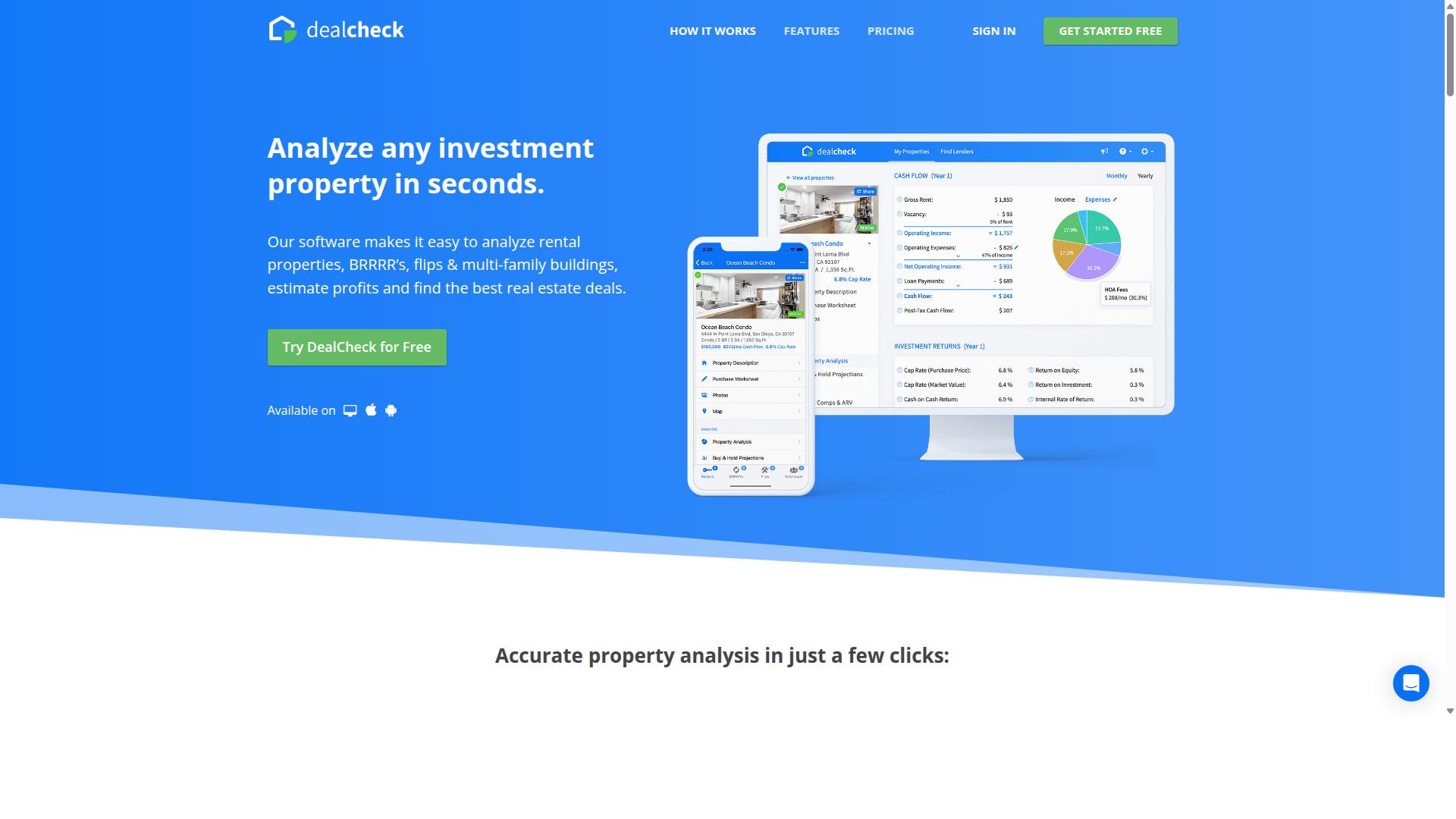
DealCheck is a real estate analysis platform that helps investors manually input property data to calculate standard investment metrics and generate pro forma reports. Users enter property details, rent rolls, and operating expenses to produce basic financial summaries for potential acquisitions.
This approach works well for straightforward calculations such as cap rate, cash-on-cash return, and equity multiple. Investors often use these outputs to compare multiple opportunities across different property types and locations.
The platform also supports sensitivity analysis, allowing users to adjust assumptions like vacancy rates, rent growth, or expense increases to see how changes affect projected returns. This feature helps identify key risk factors in a deal.
Comparable sales modeling is another component where users can input market comps to estimate property values. This process involves manual data entry for each comparable property, which becomes time-intensive as the number of deals grows.
Overall, DealCheck focuses on traditional underwriting through detailed manual input. The platform produces standard deal metrics that investors commonly review during initial property evaluation and due diligence stages.
What Is Tranchi for In-Depth Deal Analysis?

Tranchi AI's deal analysis system uses the AI Underwriting Engine to automatically pull rent rolls, expense breakdowns, and market comps, then runs sensitivity analysis across multiple financing scenarios.
The engine processes occupancy rates and vacancy loss projections to establish realistic income forecasts. Operating expenses flow through expense categorization tools that isolate fixed costs from variable line items.
Net operating income calculations feed directly into return metrics. The system produces IRR, NPV, equity multiple, and cash-on-cash returns based on capital stack inputs and projected cash flows.
Location filters narrow comparable sales data by distance, property type matching, and time-adjusted sale prices. These market comps work together with risk assessment outputs to flag overpriced assets or underperforming neighborhoods.
The platform combines 44 AI agents that support All Deal Types and Unlimited Analysis. Execution Agents handle Seller Outreach Automation while the AI Underwriting Engine maintains consistent financial modeling across the deal pipeline.
Users can apply County Foreclosure Monitoring and Tax Deed Opportunity Scanner features alongside the core underwriting process. These tools surface distressed opportunities that align with investment criteria and location preferences.
Features Compared
Three core functional areas determine how each platform handles real estate deal analysis workflows.
These areas include how deals are found, how financial metrics are calculated, and how transactions move from analysis to funding. Each platform takes a different approach in these areas.
The differences become clear when examining AI sourcing capabilities, underwriting automation, and transaction support features side by side.
AI-Powered Deal Sourcing & Scanning
Tranchi AI deploys the Off-Market Deal Scanner to crawl millions of probate court filings and auction websites using location filters and investment criteria matching.
The platform operates through 44 AI agents that scan hidden government databases, auction sites, and off-market listings. This process runs with 95% automation while applying specific investment criteria and location parameters.
DealCheck relies on user-imported or manually entered deal sources for its pipeline. Users must identify and input properties themselves rather than having the system discover opportunities automatically.
Tranchi AI also includes County Foreclosure Monitoring and Tax Deed Opportunity Scanner as part of its sourcing agents. These tools expand the range of property opportunities that enter the deal pipeline.
Automated Underwriting & Analysis
Tranchi's AI Underwriting Engine ingests rent rolls, expense breakdowns, and comparable sales to calculate cap rate, IRR, NPV, and ROI with built-in sensitivity analysis.
The engine automates debt service calculations, loan term modeling, equity multiple projections, cash-on-cash return estimates, break-even point analysis, and occupancy rate scenarios. These calculations include vacancy loss, operating expenses, and NOI projections.
DealCheck requires manual data entry for these calculations. Users must input property details and perform individual computations rather than having the system generate comprehensive pro forma models automatically.
Tranchi AI also supports All Deal Types & Unlimited Analysis across property types. The platform includes Capital Stack Structuring and Automated Term Sheet Generation as part of the underwriting workflow.
Funding & Transaction Automation
Tranchi's Automated Funding System and Transaction Automation Layer handle lender matching, document preparation, and closing workflows that DealCheck does not provide.
The Automated Funding System identifies financing options through connections to Hard Money Lenders, Private Lenders, and Cash Buyers Network. These agents match investment criteria with available capital sources.
DealCheck lacks automated funding and transaction capabilities. Users must handle lender outreach and closing processes separately outside the platform's deal analysis tools.
Tranchi AI adds Transaction Coordinator Bot and Loan Officer Bot to manage contract workflows and compliance requirements. These agents complete the transition from deal analysis to funded transaction.
Pricing Compared
Tranchi AI's Operator plan requires contacting sales for pricing while DealCheck uses a typical SaaS subscription model. Real estate investors evaluating these tools should consider how pricing structures align with their deal flow and analysis needs. The choice between transparent upfront costs and custom pricing often depends on the complexity of underwriting requirements.
DealCheck follows standard subscription tiers that scale with user volume and feature access. Most SaaS platforms in this space offer monthly or annual billing cycles with limited customization options. Investors seeking basic deal analysis tools may find this structure straightforward and predictable for budgeting purposes.
Tranchi provides a 90-Day Money Back Guarantee that allows users to test the platform thoroughly before committing. This extended trial period gives real estate professionals time to run actual property valuations and cash flow projections through the system. The guarantee reduces risk when transitioning from manual spreadsheets to AI-assisted financial modeling.
Custom crafted AI agent availability sets Tranchi apart for users with specialized underwriting workflows. Investors working with unique property types or complex financing structures can request agents tailored to their specific investment criteria. This customization capability addresses scenarios where standard analysis templates fall short.
The cancel anytime policy gives users flexibility to adjust their subscription as deal volume changes. Real estate markets fluctuate and investment activity often varies throughout the year. This flexibility prevents users from being locked into annual contracts during slower periods or when testing different analysis approaches.
Who Should Choose Tranchi AI
Real estate investors and former 9-to-5 workers investing 1-2 hours daily benefit most from Tranchi's automated sourcing and underwriting system.
Beginner investors with no experience or money find the platform especially useful for learning deal analysis without prior capital requirements. The system handles property valuation, cash flow calculations, and cap rate assessments automatically.
Small business owners transitioning into real estate appreciate how Tranchi processes rent roll data and expense breakdowns without requiring extensive financial modeling backgrounds.
Former Uber drivers seeking supplemental income appreciate the straightforward approach to IRR, NPV, and ROI calculations that eliminates complex spreadsheet work.
The platform supports users who want to review deal metrics during limited daily time windows. Sensitivity analysis and scenario planning features help investors evaluate different loan terms and equity multiple outcomes.
Tranchi's location filters and property type selections allow targeted deal pipeline management across various markets. Users can focus on cash-on-cash returns and break-even analysis without spending hours on manual calculations.
The system addresses common concerns about debt service coverage and occupancy rates through automated NOI projections. This approach reduces time spent on vacancy loss estimates and operating expense reviews.
Research suggests that investors who consistently apply investment criteria across multiple properties achieve better results than those analyzing deals sporadically. Tranchi supports this consistent approach within constrained timeframes.
Who Should Choose DealCheck
Investors who prefer manual control over every assumption in their financial models may find DealCheck's spreadsheet-based approach suitable. This platform appeals to those who want direct oversight of property valuation inputs and comparable sales adjustments without automated assistance.
Users focused on custom pro forma development often value the ability to modify every cell. DealCheck allows complete flexibility when building financial models from scratch. Investors who enjoy constructing detailed spreadsheets for deal analysis may appreciate this hands-on method.
Real estate professionals handling complex property valuation scenarios might benefit from DealCheck's granular approach. The platform supports manual adjustments to cap rate, IRR, and NPV calculations. Those who prefer building their own financial modeling frameworks can customize each element.
Investors analyzing unique property type situations often require specific modeling techniques. DealCheck provides the flexibility to adjust rent roll assumptions and expense breakdown categories. Users who need to fine-tune sensitivity analysis parameters may find the spreadsheet format accommodating.
Market analysts conducting comparable sales research can modify market comps data directly. The platform supports detailed underwriting processes where each assumption requires personal verification. Investors who want complete control over scenario planning may prefer this manual approach.
DealCheck serves those who prioritize complete transparency in their deal metrics. Users can track every calculation from cash-on-cash returns to equity multiple projections. The spreadsheet structure allows direct access to debt service calculations and loan terms modifications.
Research suggests some investors achieve better understanding of their deals through manual modeling processes. DealCheck's format lets users see exactly how changes to operating expenses or occupancy rate affect NOI and overall returns. This transparency appeals to those who want to verify each step in their risk assessment.
Who Should Choose Tranchi for In-Depth Deal Analysis
Users needing automated risk assessment across multiple financing scenarios and deal pipeline management should select Tranchi's AI Underwriting Engine.
Real estate investors who handle 1-2 hours of daily analysis benefit when 44 AI agents manage 95% of the workload. The system runs sensitivity analysis without manual data entry.
Tranchi supports all deal types and unlimited analysis. Users can model debt service coverage across different loan terms and property conditions.
The Income Engine and AI Underwriting Engine work together to test occupancy rate scenarios. These tools handle property valuation and cash flow projections automatically.
Investors focused on deal pipeline management gain from the system's ability to process deal metrics like cap rate, IRR, and cash-on-cash returns. The platform also supports equity multiple and net present value calculations.
Tranchi includes features such as capital stack structuring and automated term sheet generation. Users can compare operating expenses and net operating income across different scenarios.
Those who prefer manual data handling may find DealCheck sufficient for basic property valuation. However, investors requiring extensive scenario planning often choose Tranchi for its automated approach.
Final Verdict
Tranchi AI stands out for investors who want 44 AI agents to handle sourcing, underwriting, and transaction automation while generating an average $20K/mo in additional income.
Users rate the platform 5.0 stars based on feedback from over 2,742 investors. The service backs this rating with a 90-day money-back guarantee that removes risk from the evaluation process.
Real results appear consistently across user testimonials. Mason closed eighteen units and achieved $15,000 monthly net cash flow within eight months of implementation. Nate secured $50,000 in profit during a two-month period using the same system.
These outcomes reflect how the platform automates deal analysis tasks that typically require manual effort in traditional tools like DealCheck. The AI agents manage property valuation, cash flow projections, cap rate calculations, and IRR modeling without requiring separate software subscriptions.
Support channels remain accessible throughout the evaluation period. Email responses arrive within twenty-four hours, live chat operates Monday through Friday from 9am to 5pm EST, and phone callback scheduling accommodates different time zones. A support request form captures name, email, and phone number details for follow-up.
Recommended Resources: