
What actually moves house prices
Which of the things people blame for house prices actually move them?
It helps to sort the causes by their timescale. Some operate over years and set the level around which everything else wobbles. Others operate over weeks and explain why a particular street felt hot in March and flat in November. Confusing the two is the most common error in ordinary conversation about housing.
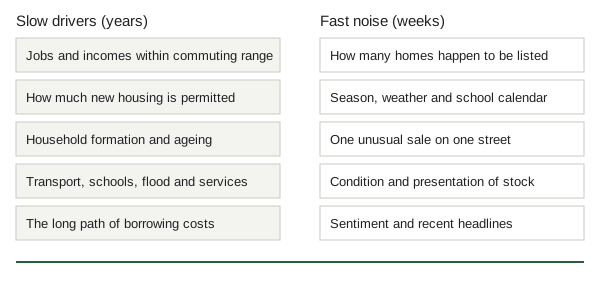
The slow drivers
Income within commuting range
Housing is bought out of income and credit. The number and pay of the jobs reachable from an address, in the time people are willing to travel, is the deepest single driver. When employment in a region grows faster than housing, prices rise regardless of anything happening in the buildings.
How much new housing is permitted
Two towns with identical demand growth and different permitting regimes end up with very different prices and very similar populations of unhappy people. Restriction converts demand into price; permissiveness converts it into buildings. Neither is free: the first raises the cost of entry, the second changes the character of a place. It is a genuine trade-off and worth naming as one.
Household formation, not population
Prices respond to the number of households, and household size falls as people live longer alone, marry later and divorce. A place with flat population can still need substantially more dwellings than it did thirty years ago. Conversely, an ageing area with large family homes occupied by one or two people has a peculiar shortage: plenty of bedrooms, not enough appropriate homes.
Access and public investment
Transport, schools, drainage and flood management are capitalised into land. When a service improves, prices near it rise even though nothing about the buildings changed; when a flood map is redrawn or an insurance market repricing arrives, prices fall for the same reason. This is the mechanism by which public decisions turn into private balance sheets, and it is worth understanding without cynicism: it works in both directions.
The cost of borrowing
Most buyers do not shop for a price; they shop for a monthly payment they can carry. When borrowing costs rise, the price that produces an affordable payment falls. But the adjustment is asymmetric and slow, because sellers resist and because owners with cheap existing loans stop moving at all, thinning the market further. Rate changes therefore show up first as fewer transactions and only later, if at all, as visibly lower prices.
The fast noise
- How many homes are listed right now. A handful of extra listings on a small market changes the negotiating position more than any macroeconomic news.
- Season. Stock and buyers both peak in spring; the winter market is thinner in both directions, which makes individual outcomes more extreme, not systematically lower.
- One unusual sale. A single buyer with a specific reason to want a specific house re-anchors an entire street's expectations for months.
- Condition and presentation. Genuine, and larger than it should be. Buyers discount visible work by considerably more than it costs to do.
- Sentiment. Real but short-lived, and mostly a story people tell about the four points above.
Things widely blamed that matter less than claimed
Cosmetic renovation rarely returns its cost. Small changes in local tax rates are capitalised but are usually swamped by access. And the general level of national house price commentary has almost no bearing on a specific street, for the reasons set out in how a housing market works.
| If someone says | Ask |
|---|---|
| "Prices here are up" | Over what period, across how many sales, and of what kind of home? |
| "Rates killed the market" | Did prices fall, or did the number of sales fall? |
| "There's no supply" | No homes existing, or no homes listed? Those have different cures. |
| "That house went for a fortune" | Who bought it, and did they need that particular house? |